


Earth's Largest Mirror Can Be Seen From Space

From Nation, For Nation - Pulse of the Nation

Pele's Curse: The Hawaiian Goddess Punishes Thieves
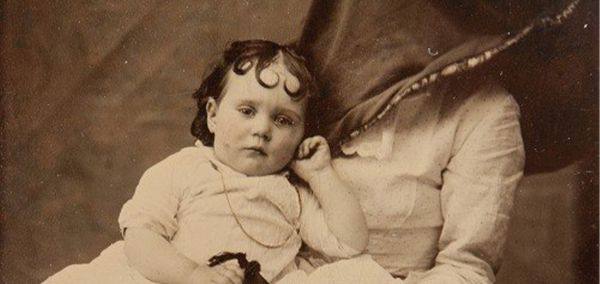
The Hidden Mothers in Victorian Baby Photos
Like spirit photography and death photography, hidden mother photography was another common practice of the Victorian era that looks absolutely creepifying now.
Many mothers, hoping to have pictures taken of their children in the early 1800s, would make a guest appearance in the photographs. However, they were usually obscured or hidden with a piece of fabric strategically draped over their bodies, or sometimes just their heads. It was also common for mothers to be cropped out of the photos, standing nearby but far enough away that they wouldn’t appear in the final images.
Now Hold Still!
As these photographs ranged from looking mildly odd to extremely disturbing; it can be hard to figure out why mothers of the Victorian era wanted to be “seen,” but not seen, in images with their children.
Daguerreotypes, or the photographs of the time, required long exposure periods that could stretch from anywhere between thirty seconds and several minutes. As any parent knows, it can be hard to keep a baby motionless simply snapping a picture with your cell phone. For a solid minute of stillness, photographers were asking a lot of the tykes. So, in many cases, their mothers would have to sit for the photograph as well in order to make sure their children didn’t fidget.
The Picture-Perfect Game of Hide-And-Go Seek
But why did the mothers hide? Why not create a portrait that portrayed familial love and affection? Linda Fregni Nagler, an Italian-Swedish artist and publisher of 2013 book, The Hidden Mother, believes the trend started because parents wanted to create “an intimate bond between the child and the viewer,” thus, leaving the mother out of the equation. Another theory stems from the fact that, in the Victorian era, photographing a loved one was such a rarity. Parents wanted images of their children alone that they could use to send to family members.
Still, others wonder if this could have been part of the long tradition of erasing a woman’s work from the eyes of onlookers. Sure, some of these portraits have been found to include the occasional father, nanny, or photographer’s assistant hidden in plain sight, but the majority of the “pictured” caregivers are mothers.
In most cases, these images are of mothers appearing with their children in their laps or beside them while otherwise being clumsily concealed to look like a piece of furniture.
→
From Globe, For Globe - Pulse of the Planet
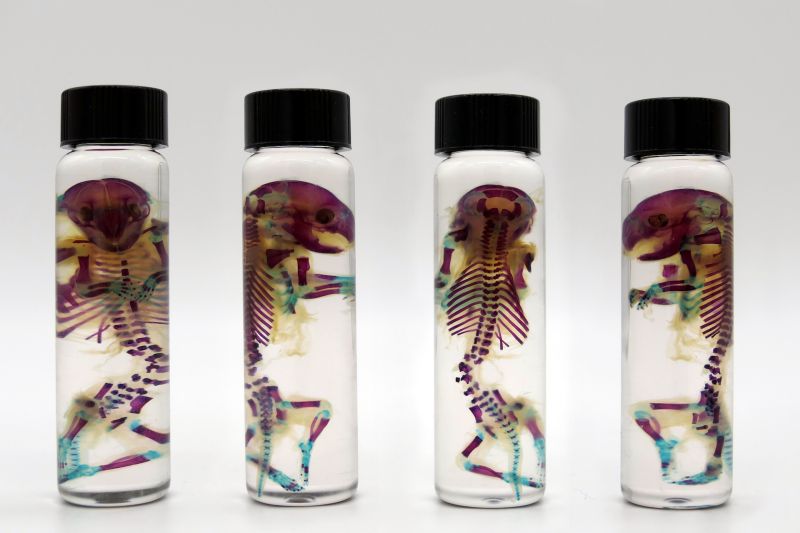
Once a specimen is rendered transparent, dyes rush to their bones and cartilage.
A dead snake curled in a circle peers out from a clear glass container as viewers peer back inside. They can see through the glass and the clear solution, and also through its skin to its neat rows of vertebrae and ribs. The bones and cartilage show intimate details of the snake’s anatomy, in the exact same position in the body as they were in life. The only differences are that the snake is dead, the skin is clear, and the bones and cartilage are dayglo pink and blue.
People who prepare animal specimens for museums and schools-as well as for personal collections-can make snakes, frogs, mice, and other small animals into scientific works of art called “diaphonized specimens.” This technique, also known as “clearing and staining,” helps people understand the internal anatomy of an animal in a unique way.
The process is complicated, involves somewhat dangerous chemicals, and takes a lot of training to perfect. Before trying it at home, curious preparators-to-be should start by volunteering at a local museum alongside staff familiar with diaphonization. In one step of the lengthy process, a preparator must soak a dead animal in a chemical called trypsin, which destroys a color-creating protein called casein. No casein, no color. After this part of the process, only a transparent version of the original animal remains.
Then, the preparator colors the specimen with types of dye that are attracted to certain substances in the body. “One has a strong affinity towards collagen, another seeks cartilage,” explains Helen Kairo, an anatomical specimen preparator. “They’re kind of like heat-seeking missiles, but they’re tissue-seeking dyes.”
As a result, depending on what dyes are used, collagen-rich bones can turn red or pink, and the cartilage left can turn blue. The result is a colorful, mystical-looking specimen that is both artistic and educational.
Kairo’s job is to prepare animal remains, including diaphonized ones, for educational purposes. She consults with museums and schools to prepare and repair materials. She also educates the public by posting on various social media platforms like Instagram. Currently, Kairo is working on an anthology about the amazing things you can learn from studying animal anatomy.
Diaphonized specimens, Kairo explains, are especially useful for certain types of animals that don’t turn out well when prepared other ways. Some of them have bones that are too small and fragile to clean and be made into stand-alone skeletons. Animals without hair and feathers are difficult to make into traditional taxidermy.
Some animals are too big for diaphonization-like adult humans. It would simply take too much time and too many chemicals to process such a big creature. However, some have diaphonized human fetuses to study their development.
Computerized imaging can be useful for these types of animals, and it is more popular these days than clearing and staining for educational institutions. Diaphonization is now something of a lost art, but at least their strange and colorful beauty makes them popular for anatomy enthusiasts to collect from Etsy.
→

Referred by ripleys.com - where the world’s most extraordinary stories are discovered and celebrated.