


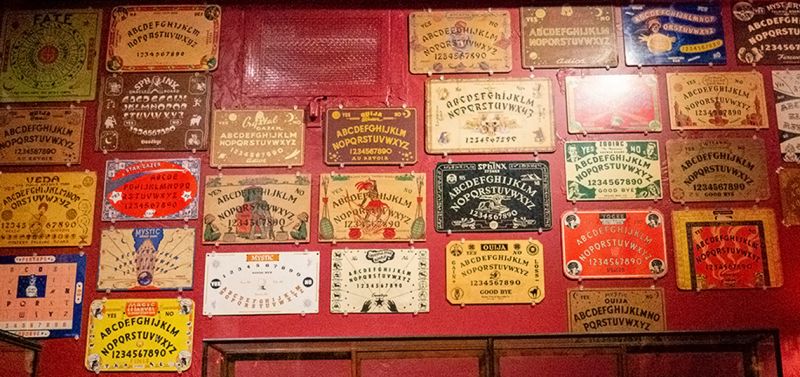
The Ouija Board: Summoner Of Spirits Or Vintage Dating Game?
From Nation, For Nation - Pulse of the Nation

Bob Pagani the Great Media Hoaxer

How the Massive Niagara Falls Ran Dry
Niagara Falls Ran Dry
Everyone knows about the day the music died, but what about the day Niagara Falls ran dry? On the morning of March 30, 1848, people living near Niagara Falls awoke to a spooky silence. What had happened to the falls’ thundering roar? On closer inspection, they saw to their horror that the Niagara River had been reduced to nothing more than a trickle.
Fish lay dead and turtles floundered around helplessly while opportunists walked on the riverbed, collecting guns, bayonets and tomahawks as souvenirs. As the incredible news spread, thousands flocked from nearby cities to witness the bizarre spectacle.
Mills and factories were forced to close because the waterwheels had stopped and worried souls, convinced that the end of the world was nigh, flocked to church, praying for the falls to start flowing again. Then the cause of the mystery was revealed-gale force, southwesterly winds had pushed huge chunks of ice to the extreme northeastern tip of Lake Erie, forming an ice dam that blocked the lake’s outlet into the Niagara River.
Finally, on the night of March 31, a distant rumble sounded from upriver, and a wall of water came rushing down the Niagara and over the falls. The ice dam had cleared. The world was up and running again.
Fall Facts:
-->It discharges 634,000 gallons of water a second.
-->It could fill every swimming pool in the US in just 3 days!
-->It would take 2 million years for all the water in the world to flow over the falls.
-->It is 95 decibels loud, close to the sound of a jet taking off.
-->The falls are constantly moving, and will eventually disappear into Lake Erie.
Ripley’s Believe It or Not! Niagara Falls
If you’re visiting the falls yourself, make sure to visit Ripley’s Believe It or Not! Niagara Falls , where you can see Justin Bieber made out of candy, a mummy hand, dinosaur eggs, and a 24-year collection of belly-button lint!
→
From Globe, For Globe - Pulse of the Planet
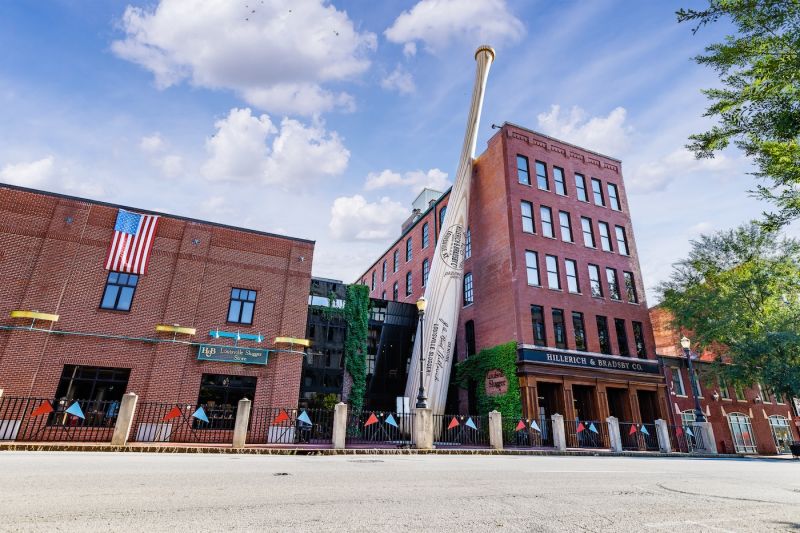
The Louisville Slugger people didn't always make bats, and the way they started making bats is rather fortuitous.
J. Frederick Hillerich
Did you know the company behind the Louisville Slugger didn’t always make baseball bats?
J. Frederick Hillerich moved his family to Louisville in 1842 and opened a woodworking shop.
The business was very popular in 1875. They were known for making bed posts, wooden bowling balls, and a very popular swinging butter churn.
The churn was the first of its kind. It used the momentum of the cream inside it to swing constantly, and the cream colliding with the sides turned it into butter.
As you can imagine, Hillerich was happy with his product and wasn’t interested in changing it. So what happened to get them into the bat business?
Bud Hillerich
In 1880, Fredrick’s son Bud became an apprentice at the family shop.
Bud was an amateur baseball player and a big fan of the Louisville Eclipse outfielder Pete Browning.
Bud made his own bats and bats for his teammates when needed, but there wasn’t a plan to make the bats commercially.
As legend has it, Bud slipped away from work one afternoon in 1884 to watch an Eclipse game. Browning had been in a hitting slump for a few games, and when his luck didn’t change in that game, he broke his bat in frustration.
Bud approached him after the game and offered to make Browning a new bat to his specifications.
In his next game with the bat, Browning broke his hitting slump with three hits. Browning, of course, told his teammates about the turn in his fortunes, and with athletes being highly superstitious, there was a surge of players to the Hillerich woodworking shop.
The Louisville Slugger
Fredrick Hillerich wasn’t interested in selling bats. He wanted the company to stick with the products that had put them on the map. Demand got so bad at times he would turn baseball players away instead of making bats for them.
But eventually, Bud convinced him of the potential upside in the business venture.
Initially, the bat was called the “Falls City Slugger.” When Bud took over the family business in 1894, he changed the name to the Louisville Slugger and registered it with the U.S. Patent Office.
Since then, baseball greats like Ty Cobb, Babe Ruth, and Lou Gehrig all famously used sluggers as their bats of choice.
And to think, if it hadn’t been for a random afternoon spent watching a baseball game instead of working, we might be talking about the Louisville Butter Churn instead of the Slugger.
→

Referred by ripleys.com - where the world’s most extraordinary stories are discovered and celebrated.